
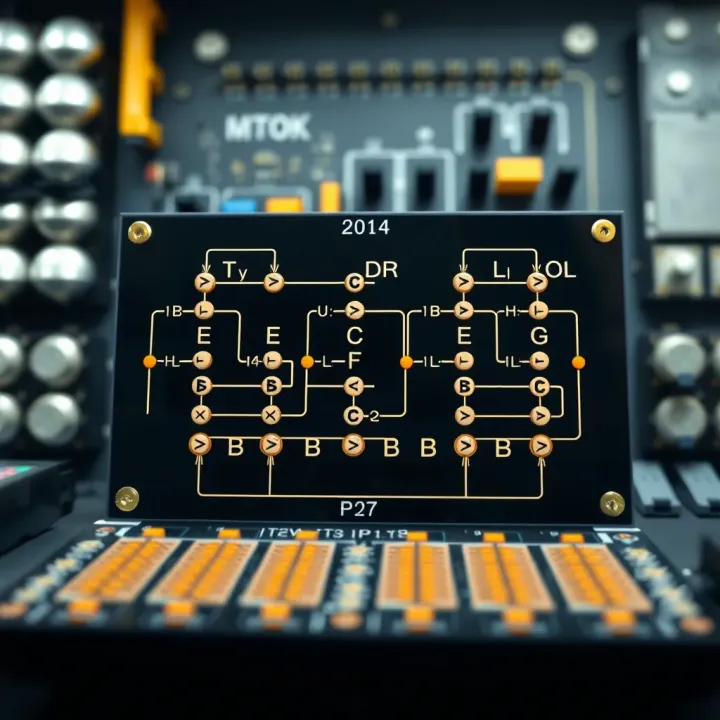
4-Bit Binary Adder Circuit Explained
Explore the 4-bit binary adder circuit, understanding its key parts, how multiple full adders work together, detailed circuit diagram, and common practical uses ⚙️📊.
Edited By
Thomas Green
A 4-bit binary adder and subtractor circuit is a foundational component in digital systems, enabling basic arithmetic operations on binary numbers. This circuit can add and subtract two 4-bit numbers, making it essential for processors, calculators, and embedded systems that require simple mathematical functions.
The core of the circuit combines a series of full adders, each handling one bit of the binary numbers. For addition, the circuit sums corresponding bits and manages carry-over to the next higher bit. Subtraction is often implemented using the same adder circuit, employing the two's complement method for negative numbers, which simplifies circuit design and saves hardware resources.

In simple terms, the circuit can process numbers from 0 to 15 in binary, perform addition and subtraction efficiently, and handle carry and borrow situations seamlessly across the bits.
Handles 4-bit binary inputs representing integers 0 to 15
Supports both addition and subtraction operations
Manages carry-in and carry-out between bits for accuracy
Uses two's complement for subtraction to reuse the adder hardware
For instance, if you want to add 9 (1001) and 6 (0110), the circuit adds each bit starting from the least significant bit, carrying over when needed, resulting in 15 (1111) in binary. Similarly, to subtract 6 from 9, it converts 6 to its two's complement and adds, producing the correct result of 3 (0011).
This versatility makes the 4-bit adder-subtractor a building block for more complex arithmetic logic units (ALUs) in microprocessors. It also finds applications in digital signal processing and control systems, where quick and reliable computations of small binary numbers are necessary.
Understanding how this circuit works lays the groundwork for grasping more advanced digital arithmetic operations, which are critical in today’s computing, trading platforms, and financial analysis tools reliant on precise and fast calculations.
Understanding binary addition and subtraction forms the foundation for grasping how digital circuits like a 4-bit binary adder and subtractor operate. These fundamental operations are central to digital computation, affecting everything from simple calculators to complex microprocessors.
Binary numbers use just two digits: 0 and 1. This simple numeral system represents all data in computers and digital devices. For example, the decimal number 9 is represented in binary as 1001. Each position in a binary number corresponds to a power of two, starting from the rightmost bit as 2^0.
Working with binary numbers allows circuits to utilise two voltage levels, simplifying electronic design compared to decimal systems. For financial algorithms and trading platforms, this straightforward representation ensures fast and error-free calculations.
Adding two single binary digits (bits) follows clear rules similar to decimal addition but limited to 0 and 1. When adding bits 0 and 0, the sum is 0; 0 plus 1 or 1 plus 0 is 1 without any carry; and 1 plus 1 equals 0 with a carry of 1 to the next higher bit. This carry bit is crucial because it influences the next step of addition, much like carrying over in decimal arithmetic.
For instance, adding binary bits 1 and 1 means you write down 0 and carry 1 forward. This carry management is vital in ensuring accuracy when dealing with multi-bit numbers.
When adding binary numbers longer than one bit, the carry from each bit addition influences the next higher bit. For example, adding 1101 (13 in decimal) and 1011 (11 in decimal) starts from the rightmost bit, moving leftwards, carrying over where needed. This ripple effect of carry bits is handled by interlinked full adder circuits.
In practical terms, this principle allows digital electronics to sum integers efficiently, supporting essential operations in computing and embedded financial systems where quick computation matters.
Subtraction in binary also deals with bits 0 and 1 but requires the concept of borrowing when the minuend bit is smaller than the subtrahend. For example, subtracting 1 from 0 cannot be done directly, so a borrow from the next higher bit occurs, turning the minuend bit into 2 (in binary terms) to complete the subtraction.
This borrow mechanism ensures that digital circuits can correctly perform subtraction bit by bit, indispensable for operations like calculating differences in stock price data and other real-time computations.
Rather than performing borrow operations directly, most digital circuits use the method of complements, specifically two's complement, to handle subtraction. Two's complement converts subtraction into an addition problem by inverting the bits of the subtrahend and adding one. This approach simplifies hardware design as the same adder circuit can perform both addition and subtraction.
For example, to subtract 5 from 9, the circuit takes 5's two's complement and adds it to 9, yielding the correct difference 4 without complex borrow management. This method is especially beneficial in microprocessors and financial calculators where space and speed are critical.
Mastery of these binary foundations makes it easier to understand how the 4-bit adder and subtractor handles arithmetic operations seamlessly, enabling precise and rapid digital computations.
Binary numbers use two digits, 0 and 1, representing powers of two.
Single-bit addition involves sum and carry; 1 + 1 produces a carry.
Multi-bit addition propagates carry across bits through full adders.
Single-bit subtraction requires borrowing if the minuend bit is smaller.
Two's complement method converts subtraction to addition for simpler circuitry.
These principles underpin the operation of digital arithmetic circuits found in almost every technological device today.

The 4-bit adder and subtractor circuit relies on several key components to perform arithmetic operations efficiently. Understanding these components is essential for grasping how the circuit manages addition and subtraction of binary numbers. The main elements include the full adder, XOR gates, and control signals that dictate the operation mode. Each plays a specific role in ensuring accurate bit-wise computation and seamless switching between addition and subtraction.
At the heart of the circuit lies the full adder, a fundamental building block that adds two single binary digits along with a carry input. Unlike a half adder, a full adder also considers carry from a previous bit, making it suitable for multi-bit operations. For example, when adding the bits 1 and 1 with a carry-in of 1, the full adder outputs a sum bit of 1 and generates a carry-out of 1. This capability allows several full adders to be cascaded for 4-bit addition, where the carry out of one adder becomes the carry in of the next.
XOR gates are critical in implementing binary subtraction within the same circuit used for addition. They invert one of the binary inputs conditionally based on a control signal — effectively creating the two's complement required for subtraction. Consider subtracting 5 (0101) from 9 (1001): XOR gates toggle bits of the subtrahend when the control input signals subtraction. This inversion, combined with an initial carry-in set to 1, transforms the operation into adding the two's complement of the number, simplifying hardware requirements by using the same adder circuit for both tasks.
Control signals determine whether the circuit performs addition or subtraction by influencing input bits and carry behaviour. Typically, a single control line sets the mode: 0 for addition and 1 for subtraction. When set to subtraction, this control activates the XOR gates to invert the second operand and sets the initial carry-in to 1 to complete the two's complement operation. This design allows the circuit to switch modes quickly without extra hardware.
The control input affects the circuit's internal data flow, altering how bits are processed. For addition, inputs pass through unchanged, and carry propagation follows standard rules. When subtraction mode is set, the XOR gates modify input bits, and the carry-in initiates the necessary complement. This change impacts the carry chain, ensuring borrows are handled correctly through the same carry logic used for addition. Such efficient re-use of components optimises space and power consumption, making the circuit ideal for compact digital systems.
Using a control signal with XOR gates lets the 4-bit adder and subtractor circuit perform two distinct operations without separate hardware, streamlining design and reducing complexity.
In summary, the interplay of full adders, XOR gates, and control signals equips the circuit with flexibility and precision, making it a foundational component in digital arithmetic units.
The design and operation of a 4-bit adder and subtractor circuit form the backbone of many basic digital processing units. Understanding this section is key to grasping how arithmetic operations get executed at the hardware level. The circuit combines simple logic blocks in a way that efficiently manages both addition and subtraction of binary numbers. This dual capability proves handy in digital calculators, microcontrollers, and arithmetic logic units (ALUs) within processors.
The core of the 4-bit adder and subtractor circuit lies in cascading four full adders. Each full adder handles a single bit of the input binary numbers along with an incoming carry or borrow. By linking these adders in series, the circuit processes 4-bit numbers one bit at a time, with the carry output of one adder feeding into the next adder’s carry input. This stepwise progression ensures accurate computation over multiple bits without oversimplifying the complexity involved in carry management.
For example, adding 1011 (decimal 11) and 0110 (decimal 6) requires the circuit to handle carries generated at bit positions 0, 1, and so forth. Using interconnected full adders guarantees proper propagation, yielding the correct 4-bit result and any overflow carry.
Carry and borrow management across bits is crucial for the circuit's reliable operation. In addition, since a carry-out from a less significant bit can affect the next higher bit, neglecting this would produce incorrect sums. Similarly, during subtraction, borrow signals flow through the bits as needed.
This carry/borrow propagation mechanism ensures each bit’s calculation accounts for previous bit interactions. Imagine subtracting 0010 (decimal 2) from 1000 (decimal 8); the borrow initiated at the second bit cascades properly, letting the circuit produce the right output without manual intervention.
Addition in this circuit relies on the chained full adders processing bits from least significant to most significant. Each full adder accepts two operand bits and a carry-in bit. It outputs the sum bit and a carry-out towards the next adder. Initially, the carry-in to the first full adder is set to zero, representing no carry over yet.
This arrangement naturally handles binary sums, including cases where combining bits exceeds the value of 1, triggering carry propagation. For instance, adding binary 1111 and 0001 results properly in 10000 through successive bit-by-bit summation and carry forwarding.
Subtraction uses the two's complement method, allowing the same hardware to perform addition and subtraction with minimal changes. Two's complement of the subtrahend (number to subtract) is found by inverting its bits and adding 1. Adding this complement to the minuend produces the difference.
Practically, the circuit does not have a separate subtractor block. Instead, it manipulates inputs via XOR gates to invert bits conditionally and sets the initial carry-in to 1. This setup effectively adds the two’s complement of the number to be subtracted, simplifying the design and reducing hardware complexity.
XOR gates flip the bits of the second operand when the circuit performs subtraction. Controlling the XOR gates with a select input allows the circuit to toggle between addition (XOR with 0, no change) and subtraction (XOR with 1, bit inversion).
The carry-in signal's initial setting to 1 during subtraction represents adding 1 to the inverted bits, completing the two's complement formation. Together, the XOR gates and the controlled carry-in enable flexible operation without separate subtractor circuitry.
This design ensures efficient switching between addition and subtraction modes, essential for compact, cost-effective digital systems such as microprocessors and digital calculators.
This compact interplay of full adders, XOR gates, and control signals exemplifies how simple logic components combine to execute critical arithmetic operations efficiently and reliably in various digital applications.
Understanding how a 4-bit binary adder and subtractor fits into real-world digital systems reveals its practical value beyond theory. These circuits form the backbone of fundamental arithmetic operations in computing hardware, making their application crucial in logic units and processor designs. Realising the integration challenges and performance impact helps in designing efficient, reliable digital devices.
Arithmetic Logic Units (ALUs) act as the computational heart of microprocessors, executing operations like addition, subtraction, and logical functions. A 4-bit binary adder and subtractor circuit is typically embedded within an ALU to perform these basic arithmetic tasks. For example, in a simple microcontroller handling 8-bit data, two 4-bit units can be combined to process the full data width. This modular approach simplifies circuit complexity and promotes reusability.
The ability of the 4-bit circuit to switch between addition and subtraction based on control signals streamlines the ALU design, ensuring swift transitions between operations. Its integration enables swift arithmetic calculations necessary for algorithms, signal processing, and decision-making processes within digital devices.
Integrating a 4-bit adder-subtractor circuit with microprocessors involves connecting it to control logic and data buses. The circuit receives operands from registers and outputs the results back for further processing or storage. Its smaller size eases embedding in compact systems like embedded devices, calculators, or digital watches where resource constraints exist.
Practical integration demands careful signal timing and control. For example, synchronising the carry or borrow signals across bits requires precise clocking to avoid errors. Modern designs also consider power consumption and heat dissipation, influenced by how intensively these arithmetic units are used.
Performance hinges on gate delays caused by successive full adders in the 4-bit chain. Though suited for basic arithmetic, it may limit the speed in high-frequency applications. For instance, processors operating in gigahertz ranges use more advanced techniques like carry-lookahead adders to reduce latency.
That said, the 4-bit circuit suits low-to-mid range systems where speed demands are moderate, but reliability and simplicity matter more. Its predictable timing and ease of testing contribute to stable performance in educational kits, industrial controllers, and IoT devices.
Despite its usefulness, the 4-bit adder and subtractor circuit has constraints. Its fixed bit width limits the range of numbers it can process directly, necessitating multiple units or wider adders for larger data. Managing carries and borrows across multiple units adds design complexity.
Another challenge lies in propagation delay, where the carry moves sequentially through each full adder, slowing down the overall operation. This delay becomes critical in processors demanding fast arithmetic operations.
Additionally, error detection isn’t built-in. Without extra circuitry, faults like overflow or underflow remain unnoticed, potentially causing incorrect computations.
In summary, while the 4-bit binary adder and subtractor circuits offer foundational arithmetic capability and ease of integration, their limitations must be addressed through design enhancements in performance-critical applications.
This knowledge guides selecting suitable arithmetic circuits aligned with the operational needs and resource constraints of the targeted digital systems.
Testing and troubleshooting are essential to ensure the 4-bit binary adder and subtractor circuit functions reliably. These steps help identify and resolve issues such as incorrect carry propagation, faulty XOR gate responses, or unexpected outputs. Optimisation then improves the circuit’s efficiency and speed, which is particularly important when integrating the unit into larger digital systems such as microprocessors or arithmetic logic units (ALUs). Neglecting these processes can lead to errors that cascade across computations, affecting overall system performance.
Common faults include incorrect carry or borrow handling across bits, which may cause wrong addition or subtraction results. For instance, a broken link in the cascading full adders can stop carry from propagating correctly. Another frequent problem involves misconfigured XOR gates, which are crucial for switching between addition and subtraction modes. Their malfunction often leads to permanently incorrect outputs for subtraction operations. Timing issues also arise, where signal delays cause glitches—this particularly affects high-speed circuits.
Simulation Techniques: Before building hardware, simulation offers a powerful way to test the circuit's logic and behaviour under different inputs. Tools like ModelSim or Multisim enable you to run extensive test cases rapidly, exposing logical flaws without physical trial and error. Simulations can reveal timing conflicts and ensure the circuit handles all carry and borrow scenarios correctly. This step saves both cost and time by catching subtle mistakes early.
Hardware Testing Procedures: After successful simulation, hardware testing confirms real-world performance. This includes using test benches with known input patterns and measuring outputs with oscilloscopes or logic analysers. Functional verification involves checking all combinations of inputs (0000 to 1111) to validate addition and subtraction results. Debugging tools help trace any misbehaviour to specific components, such as a defective full adder chip or a damaged XOR gate. Beyond correctness, hardware tests assess signal integrity, power consumption, and response time under actual operating conditions.
Optimisation techniques target reducing delay and power use while improving reliability. You might consider using faster logic families or optimising the full adder design for gate count and propagation speed. Minimising wiring distances on printed circuit boards lowers signal delay. Also, incorporating buffers can help maintain signal strength across cascaded stages. For subtraction, ensuring the XOR gates and carry-in logic switch cleanly minimizes glitches. Additionally, power gating unused parts during operation reduces energy consumption, which is beneficial in embedded or battery-powered systems.
Regular testing combined with strategic optimisation keeps the 4-bit adder and subtractor circuit robust, reliable, and suitable for modern digital electronics demands. This careful approach is vital, especially when the circuit performs critical arithmetic in real-time applications.
Explore the 4-bit binary adder circuit, understanding its key parts, how multiple full adders work together, detailed circuit diagram, and common practical uses ⚙️📊.

🔢 Explore binary arithmetic addition in digital computing—learn binary number basics, addition rules, multi-bit handling, examples, and common challenges clearly explained.

🔢 Explore how binary numbers work in computing, learn easy conversion methods, binary arithmetic, and see how it powers everyday tech gadgets! 📱💻

Explore how binary search efficiently locates data in sorted structures 🔍. Understand its workings, coding, performance, uses, limits & variants for practical application in programming.
Based on 8 reviews