

Level Order Traversal in Binary Trees Explained
Explore level order traversal of binary trees, step-by-step guide with examples, practical uses, challenges, and connections to other methods 📊🌳
Edited By
Henry Clarke
Binary trees form the backbone of many algorithms in data science and software development, especially when it comes to organising hierarchical data efficiently. Traversing a binary tree means visiting all nodes in a structured sequence, which helps retrieve or manipulate the stored information systematically. Financial analysts and data professionals often pick the right traversal technique to extract meaningful insights from tree-like data structures.
There are four primary methods to traverse a binary tree: preorder, inorder, postorder, and level-order. Each offers a distinct pattern for visiting nodes, influencing how data gets processed or presented.
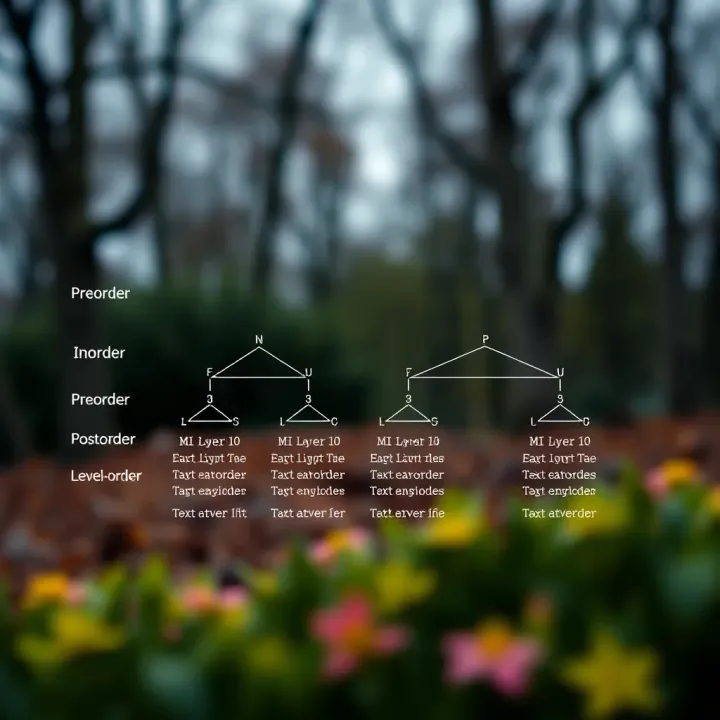
Preorder traversal visits the root node first, then recursively moves to the left subtree and finally the right. This is useful for copying trees or prefix expression evaluations.
Inorder traversal processes the left child, then the root, followed by the right child. It yields nodes in ascending order for binary search trees, crucial in sorting tasks or range queries.
Postorder traversal explores left and right subtrees before visiting the root. This method shines in scenarios like deleting a tree or evaluating postfix expressions.
Level-order traversal visits nodes level by level from top to bottom using a queue. It helps in BFS algorithms and finding the shortest path in tree structures.
Choosing the right traversal method depends on what you need to achieve with the tree data — whether it's sorting, searching, or transforming the dataset.
In practice, traversal techniques can be implemented recursively or iteratively. Recursive methods tend to be more intuitive but may face stack overflow on very deep trees. Iterative approaches, often involving explicit stacks or queues, give better control over memory and performance.
For finance professionals and students, mastering these traversal strategies unlocks the ability to work efficiently with complex data arrangements, improving algorithmic thinking and performance in various applications, including decision-making tools or automated trading systems.
Binary trees are a fundamental data structure that every trader, analyst, or student involved in computer science and data analysis should grasp clearly. At its simplest, a binary tree is a hierarchical structure where each node has up to two children. This setup allows efficient organisation of data for swift searching, insertion, and deletion, which are crucial in tasks like database indexing or financial modelling.
A binary tree is a collection of nodes where each node links to at most two other nodes, known as the left and right children. Think of it as a branching diagram where each point leads to two or fewer paths. This limitation simplifies many operations and makes binary trees suitable for tasks like representing sorted data or organising hierarchical information.
Binary trees come in various forms with distinct rules on how nodes fill levels. A full binary tree has each node with either zero or two children — no node has just one. A complete binary tree fills every level completely except possibly the last, which fills from left to right. Finally, a perfect binary tree is both full and complete, meaning all interior nodes have two children and all leaves reside at the same level. Understanding these types helps decide which suits your problem best, especially when designing algorithms where balance and completeness affect performance.
Every binary tree starts with a root node, the single entry point. From there, nodes extend into children, branching left or right. Nodes without children are known as leaves. For example, in financial data models, the root might represent the starting point of analysis, with leaves representing final computed values or outcomes. Recognising these components clarifies traversal operations and how data flows through the tree.
Traversal means visiting each node in a binary tree in a specific order. This becomes essential when extracting or processing data, such as evaluating expressions in programming or parsing hierarchical records. Without structured traversal, accessing information buried deep in the tree would be haphazard and inefficient.
One challenge is choosing the right traversal method that fits the problem — whether preorder, inorder, postorder, or level-order. Each presents a unique sequence, affecting how results appear and how algorithms perform. For instance, inorder traversal yields sorted data for binary search trees, which is handy for financial searches or report generation. Moreover, managing stack or queue data structures during traversal can be error-prone if not handled carefully, potentially leading to infinite loops or missed nodes.
Traversal techniques serve as building blocks for more complex algorithms like insertion, deletion, balancing, or searching. For instance, many search operations rely on inorder traversal to efficiently locate data in binary search trees aligned to stock data or client records. Similarly, tree-based compression algorithms depend on postorder traversal to evaluate expressions or encode information.
Traversal isn't just a mechanical step; it directs how meaning and value are extracted from complex tree structures prevalent in trading systems and data analytics.
In short, knowing the structure of binary trees and mastering traversal methods equips you to handle data more effectively, design better algorithms, and make informed decisions based on hierarchical or sorted datasets.

Depth-first traversal methods focus on exploring as deep as possible along each branch before backing up. These methods are fundamental when dealing with binary trees because they provide systematic ways to visit every node efficiently. Depth-first traversals are key in many algorithms like expression evaluation, tree copying, and sorting, wherein the node visitation order affects the outcome.
Traversal order and steps: Preorder traversal visits the root first, then recursively visits the left subtree, followed by the right. For example, in a tree representing tasks, this method helps to process the main task before its subtasks. This straightforward root-first approach suits scenarios that require handling a node before its children.
Applications such as tree copying: One practical use of preorder traversal is making an exact copy of a binary tree. Since it visits nodes before their descendants, it ensures the root and structure are replicated top-down. For instance, cloning a file directory tree benefits from this order to reconstruct folders and subfolders accurately.
Recursive implementation basics: Implementing preorder recursively involves calling the function for the current node, then left child, then right child. This simplicity allows easy understanding and clean code. However, recursion's stack usage might be a concern for very deep trees, especially in environments with limited memory.
Iterative approach with stack usage: An alternative to recursion uses an explicit stack to track nodes, mimicking the call stack. The method pushes the root first, processes it, and pushes right then left children to ensure left is processed prior to right. This iterative approach is useful when avoiding recursion overhead or in environments restricting stack depth.
How inorder traversal visits nodes: Inorder visits the left subtree first, then the node itself, and finally the right subtree. This left-node-right sequence respects the natural order of elements in many structures. Think of an alphabetised dictionary where words in left pages come before the current, fitting for alphabetical or numerical sorting.
Its importance in binary search trees: In a binary search tree (BST), inorder traversal returns values in sorted order, making it useful for retrieving sorted data without additional sorting. For example, financial analysts working on portfolios stored in BSTs can quickly access sorted asset prices or dates.
Recursive and iterative implementations: Recursive inorder is straightforward: traverse left, visit node, traverse right. Iteratively, a stack helps to keep track of nodes, moving as left as possible, then processing, and shifting to right children. The iterative method often improves efficiency and prevents stack overflow issues seen in deep trees.
Node visitation sequence: Postorder follows left, right, then root node visitation. This approach delays treating the current node until all subtrees are processed. It is especially helpful where child nodes must be dealt with fully before the parent.
Use cases like expression tree evaluation: Expression trees representing mathematical formulas are evaluated naturally through postorder traversal. It calculates values for operands before applying the operator at the parent node. For instance, in compiler design, this order is essential for syntax tree evaluation.
Implementing recursion and iteration: Recursive postorder is intuitive but can consume stack space with deep trees. Iterative implementation is trickier than preorder or inorder, often requiring two stacks or carefully tracking previously visited nodes to ensure correct order. Choosing between recursion and iteration depends on tree size and operational constraints.
Depth-first traversals provide varied node visiting patterns. Understanding their nuances helps pick the right traversal method matching your algorithm's needs and resource limits.
Level-order traversal visits each node in a binary tree level by level, starting from the root and moving downwards. This contrasts sharply with depth-first methods, which explore as far along branches before backtracking. Level-order is especially relevant where you need to process nodes in the order of their distance from the root, such as in networking where you might want to find the shortest path in a tree-like structure.
Level-order traversal works by visiting all nodes at the present depth before moving to the next level. Imagine a corporate hierarchy: starting at the CEO (root), you move on to all direct reports (first level), then their subordinates (second level), and so forth. This method ensures nodes closer to the top get handled before those deeper in the tree.
This approach is practical in financial modelling or organisational data analysis where hierarchical relationships matter. For example, when analysing reporting lines in a company, processing immediate subordinates before moving down helps in accurate aggregation of data.
Level-order differs from depth-first traversals like preorder or inorder, which dive deep into one branch before moving to others. Depth-first methods suit scenarios like evaluating expression trees or binary search trees where node ordering is critical. On the other hand, level-order traversal looks across the tree breadthwise—helpful for tasks that require uniform progression.
Queues form the backbone of level-order traversal implementations. The algorithm starts by enqueuing the root node. Then, it repeatedly dequeues a node, processes it, and enqueues its children in left-to-right order. This ensures nodes are visited level by level.
Consider a scenario where you're simulating stages of project approval in a company. Each level of the tree could represent a stage, and visiting nodes in order ensures no later stage is processed before earlier ones. The queue maintains this natural order efficiently.
Common use cases for level-order traversal include:
Shortest path or distance calculations: Finding the nearest node with a certain property.
Serialization and deserialization: Saving a tree structure or reconstructing it, where preserving level information is vital.
Broadcast simulations: Modelling how information spreads level-wise in networks or organisations.
These practical uses show why level-order traversal is often preferred when you need clarity on the hierarchical progression or when processing nodes in ascending order of their depth is important.
Level-order traversal provides a straightforward way to explore tree structures breadthwise, simplifying many common tasks in data analysis, networking, and hierarchical modelling.
Selecting the appropriate traversal method significantly impacts how efficiently you can access or process data in a binary tree. Each traversal technique offers different ways to navigate the nodes, and the choice depends on the specific task, tree structure, and performance needs. For instance, preorder traversal works well for copying trees, while inorder suits binary search trees (BST) to retrieve sorted data. Understanding the trade-offs between recursive and iterative implementations helps you optimise speed and memory usage.
Recursion naturally fits tree traversals since trees themselves are recursive structures. Recursive code is concise and easier to understand, making it suitable for smaller trees or educational purposes. However, recursion can lead to high memory consumption with deep trees due to extensive call stack usage, risking stack overflow errors especially in systems with limited resources.
Iteration uses explicit data structures like stacks or queues to replicate recursion without growing the call stack. This approach is often faster and safer for large or unbalanced trees, as it avoids overhead from function calls. However, iterative solutions can be more complex to implement and harder to read, which might slow down development.
Stacks and queues play a vital role in iterative traversal methods. A stack supports depth-first traversals by storing nodes yet to visit, mimicking the call stack in recursion. Queues enable breadth-first or level-order traversals by processing nodes level by level. These data structures provide control over traversal order and help manage memory better, especially when dealing with millions of nodes in big data or financial transaction trees.
Your choice of traversal should align with the tree's type and your goal. For example, inorder traversal offers sorted access in BSTs, which is handy in financial applications where quick lookup of sorted values is necessary. Postorder is useful for evaluating expressions represented as trees, common in compilers or calculators.
Consider the purpose: if you need to process parent nodes before children, preorder fits well; but for deleting or freeing tree nodes safely, postorder ensures child nodes are handled first. Understanding these distinctions avoids misapplication and inefficient traversals.
Performance also matters, especially with large datasets. Recursive methods may slow down when trees grow tall or uneven, affecting real-time financial data systems. Iterative methods with well-managed stacks or queues typically maintain consistent performance. Besides time complexity, memory usage influences which technique works best under server or mobile device constraints.
Choosing the right traversal method balances clarity, efficiency, and suitability for your data structure and task. This understanding underpins robust software development and data analysis in trading platforms, investment software, and more.
Binary tree traversals go beyond mere theory—they play a significant role in various computer science and software development tasks. Traversal methods become essential when dealing with complex data structures and algorithms, improving both the efficiency and clarity of operations.
Syntax tree parsing is a prime example where binary tree traversal shines. During compilation or interpretation of programming languages, the source code is converted into a syntax tree representing the program’s grammatical structure. Traversing this tree, often using preorder traversal, allows compilers to process expressions, statements, and declarations in the correct order. This parsing step is vital for semantic analysis and code generation, making traversal methods a backbone of programming language tools.
Binary search tree (BST) operations rely heavily on traversal techniques to function effectively. For instance, inorder traversal retrieves BST elements in sorted order, which is critical for tasks like searching, inserting, or deleting nodes while maintaining order. Efficient traversal ensures that these operations execute quickly, enabling applications like databases or indexing systems to handle large volumes of data without lag.
When it comes to data compression and expression evaluation, postorder traversal finds its importance. Expression trees, which represent arithmetic or logical expressions, get evaluated by visiting subtrees before parent nodes—a natural fit for postorder traversal. Compression algorithms might also depend on tree structures where traversing nodes in specific orders helps encode data efficiently, reducing file sizes and improving transmission speeds.
Reducing time complexity is crucial to handle large datasets or real-time applications. Optimised traversal algorithms avoid redundant visits by carefully managing recursion or iterative loops. For example, tail recursion can reduce stack overhead, while iterative methods with explicit stacks help bypass the limits of recursive calls. This optimisation translates into faster processing and better scalability.
Memory management during traversal demands careful attention too. Recursive traversals risk stack overflow with deep trees, so iterative techniques using queues or stacks come handy, keeping memory use predictable. Additionally, traversals that prune unnecessary branches early reduce both processing time and memory load, proving useful in scenarios like searching within large hierarchical databases where every cycle counts.
Practical use of binary tree traversal is not just about correctness—it’s equally about making algorithms efficient and adaptable to real-world constraints.
Understanding these applications helps you pick the right traversal technique for your project, ensuring your code is both effective and performant.
Explore level order traversal of binary trees, step-by-step guide with examples, practical uses, challenges, and connections to other methods 📊🌳
Explore how to calculate the maximum height of a binary tree 🌳, its importance in algorithms, and impact on data structures for programmers and students.
Explore how to measure the maximum height of a binary tree 🌳, understand its role in data structures, and learn efficient calculation methods with examples 🔍.

Explore how the Optimal Binary Search Tree algorithm 📚 organizes nodes by access chances to cut search time, with dynamic programming insights and key applications.
Based on 5 reviews